
Visitors to a particular building on the corner of Flatbush and DeKalb in Brooklyn reportedly hear an unexpected sound: a rumbling, cascading wall of sound, and their first reaction is to search for the speakers. They don’t exist.
They are listening to a Wurlitzer theater organ, which has two thousand pipes, seven thousand moving parts a blower that is half the size of a passenger jet engine. All of these components work together to fill a room in a way that no electronic device can ever quite match. It’s the type of thing that is difficult to fully comprehend until you are standing in it.
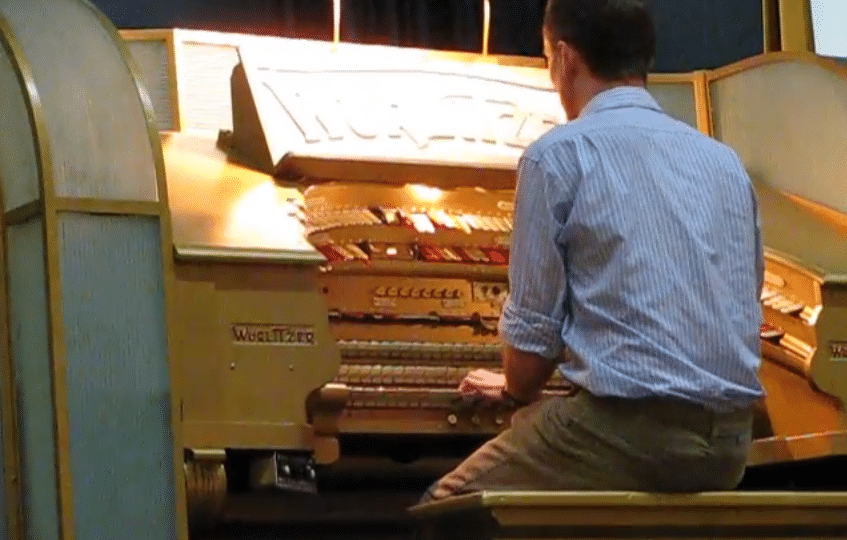
The Brooklyn Paramount Wurlitzer, officially known as a Publix 4 Opus 1984, has been housed inside the Brooklyn campus of Long Island University since 1928. That is almost a hundred years.
It is somewhat ironic that it was placed in a theater built especially to display talking pictures, since the purpose of a theater organ was to provide sound for silent movies. It wasn’t even desired by Paramount Pictures. They were effectively coerced into accepting delivery by the Wurlitzer Company through an apparently unbreakable contractual arrangement.
The organ features 257 stop pads above its four-keyboard console and 26 “ranks” of pipes arrays of individual pipes that are tuned and voiced to resemble various instruments. You can hear more than just an organ if you pull those stops in the correct combinations.
A violin section, a harp, a marimba, a drum kit, and a full piano are all mechanically produced by the same instrument. It was referred to as a “one-man orchestra” by organists of the time. That wasn’t language used in marketing. It was essentially accurate.
Although the scale of the Wurlitzer theater organ is truly astounding, it is not the only thing that sets it apart from a church organ. The theater organ was designed to react emotionally in real time.
Without a conductor or a pit full of musicians, the organist was guiding the mood of the entire audience, moment by moment, rather than providing accompaniment. In the past, Jessie Crawford, who was billed as the “Poet of the Organ”, would ascend on a platform lift from beneath the Paramount stage, playing as he came out of the shadows. The 1928 Brooklyn Paramount premiere drew 25,000 viewers. It’s probably safe to assume that they remembered it in part because of the organ.
The device was neglected for decades before being gradually saved from flood damage. In 1987, water seeping through drainage pipes destroyed some of the 16-foot wooden pipes and rotted the leather valves. More damage was caused by a second flood in 2003.
The New York Theater Organ Society, a volunteer organization that has been maintaining the Brooklyn Paramount’s Wurlitzer since 1965, has raised the majority of the $100,000 needed for the repairs each time. Bob Walker, one of those volunteers, reportedly devoted thousands of hours over the course of 27 years to maintaining the instrument’s playability.
The Wurlitzer may have survived because it was disregarded for such a long time. In the 1960s, the theater was transformed into a basketball court while the balconies were demolished and the seats were removed; the organ remained beneath the floor, dormant and mostly forgotten. No one took it apart. Many of Wurlitzer’s two thousand theater organs were sold for parts, but no one did. It did nothing but wait.
Standing in a building and realizing that one of the most intricate mechanical musical instruments ever made is practically hidden inside, maintained by a rotating group of volunteers who do it out of love, is truly bizarre.
It appears that the original instrument’s craftsmanship was so accurate that, more than 85 years after it was intended to last 25 years, it was still playing in concerts. It’s not a small detail. That is the Wurlitzer Company creating something completely different from what anyone requested.
It’s unclear if the Brooklyn Paramount itself will receive the preservation it merits. The installation of a full-size screen to show silent films accompanied by the organ has been discussed as a possible renovation. This would return the story to its beginning in the most satisfying way possible.
Without a single amplifier in the room, the Mighty Wurlitzer is still present, playable, and able to cause the walls to vibrate. It seems that you can feel it in your chest when you hear it.
FAQs
1. Where is the Brooklyn Paramount Wurlitzer located?
It’s housed inside Long Island University’s Brooklyn campus, at Flatbush and DeKalb.
2. How does the organ produce sounds of different instruments?
Its 26 ranks of pipes, pulled in combinations, mechanically replicate violins, harps, pianos, and more.
3. Why did the organ survive when so many others were scrapped?
It was forgotten beneath a converted basketball court, so nobody dismantled it for parts.
4. Who has kept the Wurlitzer playable over the decades?
Volunteers from the New York Theater Organ Society, raising funds and donating thousands of hours.
5. What made theater organs different from church organs?
They were built to guide audience emotion in real time, without a conductor or orchestra.