
Hearing Sergei Rachmaninov play the piano in 1925 has a subtle unnerving quality. The man died in 1943, yet here he is, pedaling through his own C-sharp minor prelude with that distinctive weight in the left hand and that specific pause before the melody lands. This is not because the performance is poor; rather, it is remarkable. It feels more like listening in than it does like history.
The player piano roll, a punched paper ribbon that initially resembles the output of an old-fashioned adding machine, is the medium in charge of this. Notes are represented by holes. The piano plays itself thanks to a pneumatic mechanism that receives the roll.
The technology reached its zenith around 1920, when player pianos took over living rooms in the same way that streaming services now occupy phones. This allowed families to enjoy Chopin in their parlors without having to hire a pianist. The technology itself isn’t what makes the Rachmaninov rolls truly amazing. Before anyone realized it was capturing anything permanent, that’s what the technology happened to capture.
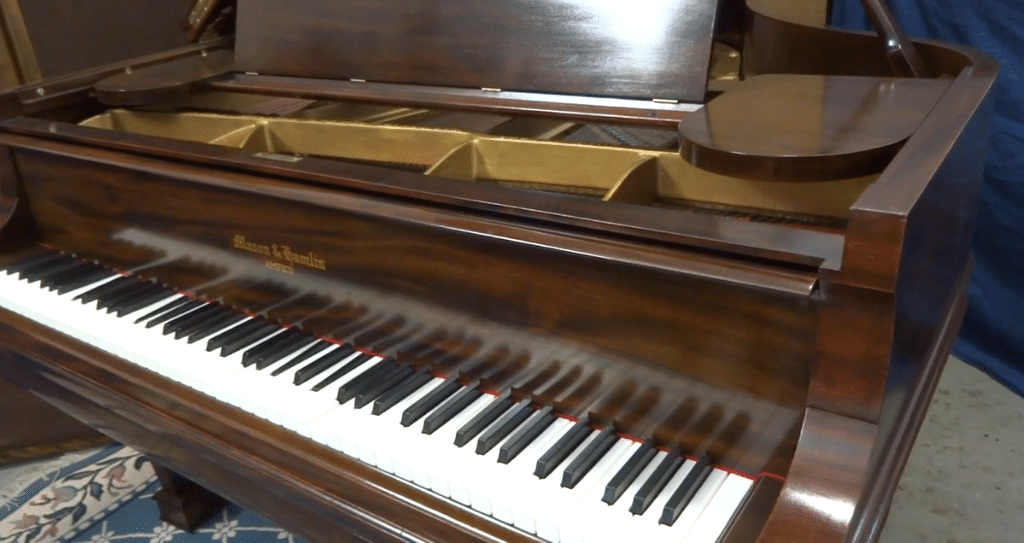
Rachmaninov recorded for one of the more advanced roll-cutting systems of the time, the Ampico system. The Ampico system was able to register gradations of dynamics, the subtle difference between a note played with quiet intention and one struck with sudden force, in contrast to standard rolls, which only encoded which notes were struck and when.
This was crucial because the whole point of Rachmaninov’s technique was to vary his touch. He didn’t write large, overt pieces of music that were supposed to be hammered into shape by performers. The rolls most likely caught the subtlety of the architecture.
It’s worth stopping to consider how peculiar this is. The rolls were partially cut by hand, partially by mechanical tracing occasionally; the composer was seated at a special recording piano whose keystrokes could be recorded and subsequently recorded on paper.
According to reports, Rachmaninov was picky about the process, approving versions that were different from his concert performances at times and requesting corrections at other times. This brings up the question that musicologists have been silently debating for decades: are the rolls records of Rachmaninov’s actual playing style or records of his desired performance style?
The difference may not be as important as it first appears. The rolls preserve a series of phrasing decisions, tempo changes, instances in which he hurried a little, and instances in which he appeared to hold back as if he had an idea. These are not the choices made by a composer exhibiting proper execution. These are the choices made by a performer who has been familiar with the music long enough to have thoughts about it that are difficult to express on a score.
The remarkable accuracy with which these rolls can now be replayed thanks to modern piano technology has drawn significant interest from academics and pianists. When you listen to a well-restored playback, you get the impression that the distance between reality and reconstruction has become uncomfortably small. This isn’t comfortable for everyone.
Some contend that the physical weight of a living hand and the breathing micropressures produced by the human body cannot be captured by a piano performance alone. That is most likely the case. The rolls don’t promise to take the place of the performance. More modestly, they say they remember it.
The larger narrative here relates to something that composer George Antheil experienced viscerally a century ago when he was creating music especially for player pianos that were practically impossible for human hands to perform. Antheil considered the player piano to be an unrestricted machine.
Rachmaninov employed the same technology for nearly the opposite purpose: to maintain the aspects of his playing that were most uniquely human. There is still tension between those two visions. It’s still unclear if flawless mechanical replication or something that acknowledges its own flaws will be the future of recorded music. Tentatively, the rolls imply that perhaps the point is imperfection.
There’s no doubt that without them, a large portion of Rachmaninov’s true voice would have been lost. His early phonograph recordings are valuable historically, but they are also distorted, compressed sonically damaged due to the acoustic recording horns’ inability to capture the full range of a concert grand.
The rolls get closer when they are played back on contemporary instruments that have been carefully calibrated. Not completely. But in 2026, it was closer than anyone in 1925 would have imagined.
When listening to one of these reconstructions late at night, it’s difficult not to notice that the piano seems to breathe in a way that should not be possible with pure mechanical reproduction. It’s unclear if the technology is operating properly or if there was something in the original encoding that hasn’t been fully explained. The question, like everything else, was left on the paper by Rachmaninov.
FAQs
1. What makes Rachmaninov’s player piano rolls historically significant?
They capture his actual phrasing decisions and tempo choices before acoustic recording technology could.
2. How did the Ampico system differ from standard player piano rolls?
It recorded dynamic gradations, not just which notes were struck and when.
3. Were the rolls faithful recordings of his live performances?
Rachmaninov sometimes approved versions that differed from his concert performances.
4. Why do modern pianists and musicologists study these rolls?
Advanced playback technology now reproduces them with uncomfortably close accuracy to the original.
5. What can’t the rolls capture about Rachmaninov’s playing?
They cannot replicate the physical weight and micropressures of a living hand.