
A player piano that hasn’t moved in decades has an almost eerie quality. The roll mechanism was silent, the pedals were motionless; the entire thing sat in a corner like a piece of furniture that had forgotten its purpose.
If you visit enough old houses, you will come across one where nearly all of the owners will tell you the same tale: “It belonged to my grandmother”. It used to play beautifully. It would be wonderful to have it functioning once more. It is more difficult to determine whether that is truly feasible and what is actually needed than most people anticipate.
A player piano is not a single device. There are two: in addition to the piano’s internal pneumatic player mechanism, which consists of bellows, valves, pouches, and a tubing tracker bar that work together to create the vacuum-powered system that actually moves the keys, there is the piano itself, with its strings, hammers, soundboard, and action, all of which deteriorate over time in different ways. Both must be assessed independently.
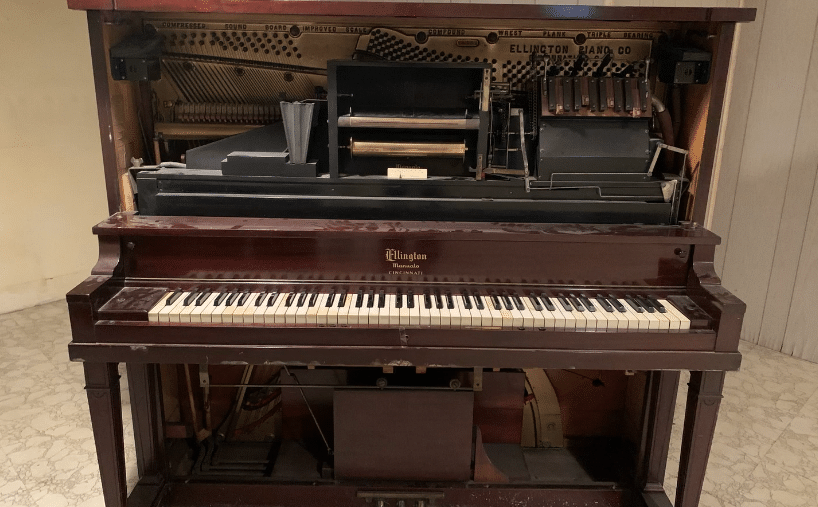
Each must be restored independently. A piano with a cracked soundboard and dead strings will sound exactly like a broken instrument when a beautifully rebuilt player mechanism pumps air through it.
First-time restorers often underestimate the scope of the mechanical side. A vintage player piano’s pneumatic system depends on airtight rubber and leather parts that were just not made to last a century. Bellows break.
Pouches don’t work. The tubing breaks. Valves cease to seal. The cam shaft’s rotation can be disrupted by even a single tiny air leak in the motor section, resulting in unpredictable, uneven roll playback. Patching individual parts rarely yields dependable results.
Restoration shops that specialize in this work will usually rebuild the entire player system from the ground up, including new bellows, tubing, rubberized cloth, and fresh leather on the valves. One seasoned restorer puts it this way: “Even a one-legged man can pump the piano with ease”.
Depending on the instrument’s condition and the extent of the work, costs can vary significantly. Depending on the model and degree of damage, full restorations from reputable shops that include a full piano rebuild in addition to the player mechanism typically start at about $25,000 and can go up significantly from there. Most people are surprised by that figure.
Most likely, it shouldn’t. Between the piano action and the player mechanism, these pianos have up to 10,000 moving parts. Skilled technicians can work on a single instrument for weeks. For a particularly complicated project, a two-year restoration timeline is not unheard of. Typically, there is a waiting list.
What might go wrong? Actually, quite a bit, particularly when it comes to amateur or inexperienced work. Shortcuts like homemade adhesives, homemade sealants, or improper leather grades will fail in a few years and occasionally result in further damage because the materials are so important.
One of the most frequently overlooked parts of low-cost restorations is the valves, which control airflow through the pneumatic system. They need perfectly polished metal seats, a valve leather that is truly airtight, and a properly weighted travel of about.040 of an inch.
If you do that incorrectly, the piano might play, but it won’t play correctly. Since the movable board can be replaced with period-appropriate wood and the main board can be sanded flat and resurfaced, it is usually preferable to allow the movable board to crack rather than the stationary board when pneumatics split during removal.
The cabinet should be the last consideration when making a restoration decision because it is frequently the first thing people notice. Replated pedals, replica decals that match the original hardware, and quarter-sawn oak restored using a closed-pore technique can all make a refinished case visually stunning. Cosmetic work increases expenses without improving playability.
Before speculating about the piano’s final appearance, it is worthwhile to have an open discussion with a technician about what the instrument truly requires. If they are structurally sound, many original cases should be kept exactly as they are.
Safety is one issue that is neglected. For decades, old player pianos have been closed, gathering dust that could harbor mold, bacteria, or worse. When opening and cleaning a vintage instrument’s interior, one should wear gloves and a suitable dust mask, use a vacuum before using compressed air, and wipe washable surfaces with a diluted vinegar solution instead of harsh chemicals.
Those who went in with reasonable expectations, realizing that the process takes time, that the cost reflects true craft, and that the end product is an instrument that can be played again for another generation, are almost always the ones who leave a full restoration most satisfied.
It truly does work when it does. The rolls rotate. Without a hand touching them, the keys move. A 100-year-old mechanism operating precisely as intended. It’s difficult not to think that’s a little amazing.
FAQs
1. How much does a full player piano restoration typically cost?
Full restorations usually start around $25,000 and can go significantly higher.
2. Why do the pneumatic parts need to be completely rebuilt?
Century-old rubber and leather components inevitably fail, making patchwork repairs unreliable.
3. How long does a professional restoration take?
Expect weeks of skilled labor, with complex projects sometimes spanning two years.
4. What happens if the valve work is done incorrectly?
The piano may play, but it won’t play correctly.
5. Should cosmetic cabinet restoration be the top priority?
No — structural and mechanical soundness always matters more than appearance.