
A strip of perforated paper, somewhere in a climate-controlled archive, shows Sergei Rachmaninov performing a piece he recorded in New York circa 1926. Something more unusual and possibly more personal than a studio pressing or a phonograph reproduction. In addition to encoding the notes he played, the holes punched into that roll also approximate the weight behind each note. It’s difficult not to find that a little eerie.
The American Piano Company, which was established in 1908 as a result of the merger of several significant manufacturers, including Chickering & Sons and William Knabe, created the Ampico reproducing piano system. The business realized early on that recording performances was more important than just selling pianos.
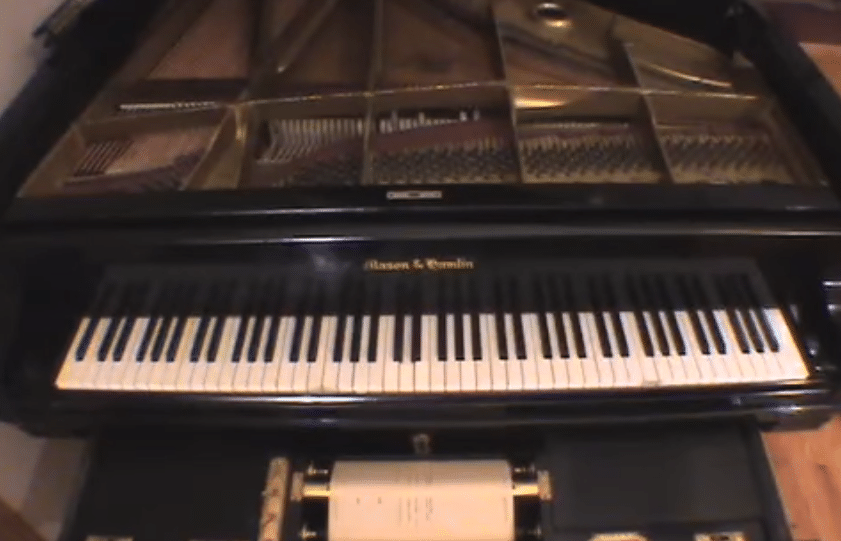
Charles Fuller Stoddard, a mostly self-taught engineer who had been working covertly on a recording and playback system since at least 1908, gave them his patents. In order to complete circuits during key presses and record note events onto moving paper rolls, his early designs used electrical contacts fastened to each piano key or hammer. Each mark’s length matched the amount of time a note was held. Theoretically elegant, but practically challenging.
Around September 1911, the first version was made available to the public. It was first known as the Artigraphic and then the Stoddard-Ampico. By 1916, “Ampico,” an acronym derived from “AM”erican “PI”ano “CO”mpany, had become the sole branding choice.
In a well-planned performance at the Hotel Biltmore in New York that same year, pianist Leopold Godowsky alternated between playing the Ampico rolls live and performing himself, seemingly challenging audiences to notice a difference. Clearly impressed, the New York Globe described it as an “almost human instrument” that produced the outcome. Depending on who was in the audience, that could have been a compliment or something more disturbing.
There was a serious drawback to the original Ampico. Everything was played at one volume. You had notes and durations, but no dynamics, pianissimo, crescendo, or held-back tension prior to a chord landing. Although it didn’t replicate a performance, it was technically a reproducing piano in the sense that it replicated notes. Not just yet. The breakthrough occurred in 1925 when Clarence N. Hickman, a young Ph.D.-holding engineer who had joined the company in 1924, created a new recording device.
He employed a device known as a “spark chronograph” to record electrical sparks onto chemically treated paper in order to measure hammer velocity. The volume of a note is precisely determined by the hammer velocity, which is the force with which a key is struck. The Ampico was finally approaching what had always seemed unattainable: not just what a pianist played, but how they played it by capturing that.
It wasn’t just a mechanical process even back then. In order for the reproducing piano to truly replicate the expressive subtleties of the original performance, Ampico hired a group of musical editors who manually examined the recorded data, analyzed dynamic information, and refined the coding.
A human being in the loop, deciphering and adjusting the machine’s best estimate of a performance’s meaning, has a subtle allure. The editors attempted to maintain the emotion while the technology recorded the facts. It remains to be seen if they were consistently successful. Most likely not all the time. It was a serious attempt.
These days, those rolls of paper aren’t merely kept in storage. Using specialized piano roll scanners, archivists and enthusiasts have been scanning them, turning the holes and marks into MIDI files that can be replayed on a contemporary digital player piano. Through its Piano Roll Archive, Stanford University is currently working on a digitization project.
For this type of preservation work, Terry Smythe created his own unique scanner. The Piano Roll Scanner 2.0 was created by the Italian Mechanical Music Association. A century later, the same performance that once required a pneumatic reproducing grand piano in a concert hall can now be played back through a Yamaha Disklavier in someone’s living room using the same velocity data that Hickman’s spark chronograph recorded in the middle of the 1920s.
It’s possible that the engineers of the Ampico were never quite able to achieve the flawless fidelity to a pianist’s touch. Even Stoddard’s most sophisticated systems needed human editors to complete the task. There is something worth appreciating about the ambition itself: the notion that a performance was not only sound but also intentional. That a key’s pressure is just as important as the key itself. These days, modern digital pianos take that for granted. To demonstrate this, engineers created spark chronographs a century ago.
FAQs
1. What is the Ampico reproducing piano system?
A player piano that recorded and replayed actual pianist performances, including dynamics.
2. Who invented the recording technology behind the Ampico?
Charles Fuller Stoddard developed the original system using electrical contacts on piano keys.
3. What was the major flaw in the original Ampico?
It captured notes and durations but couldn’t reproduce any dynamic variation.
4. How did Clarence Hickman solve the dynamics problem?
He measured hammer velocity using a spark chronograph to capture note volume accurately.
5. How are Ampico piano rolls being preserved today?
Archivists scan them into MIDI files, including through Stanford University’s Piano Roll Archive.