
Entering a room and hearing a grand piano play itself has a subtle surreal quality. Not a hand on the keys. No sheet music. The bench is empty, but there are only hammers hitting strings, creating something distinctly alive. It’s the kind of thing that causes you to pause and reevaluate your preconceived notions about music and blurs the boundaries between them.
The player piano is not brand-new. It originated in the 1880s and developed into a household mainstay by the early 20th century; by the time electric recordings took over living rooms, it had been largely written off as a curiosity. An intriguing development is currently taking place. The player piano, which was once written off as a mechanical novelty, is now being viewed differently as AI music tools like Suno create entire songs from written sentences. As a sneak peek at where things were already going, rather than as a relic.
“People think of digital as this new thing”, states Allison Wente, an associate professor of music at Elon University who studies the player piano and musical labor. The player piano actually dates back to the 1880s. The initial mechanism was tastefully straightforward. Rolls of perforated paper were passed over a pneumatic tracker bar; as air passed through the holes, hammers were triggered, creating notes.
With just the ability to pump a treadle, a family without a talented pianist could suddenly fill their parlor with ragtime or Chopin. Quality music “without the least preparatory study” was promised in one advertisement from 1909. These days, that pitch sounds familiar because it’s basically what AI music companies say.
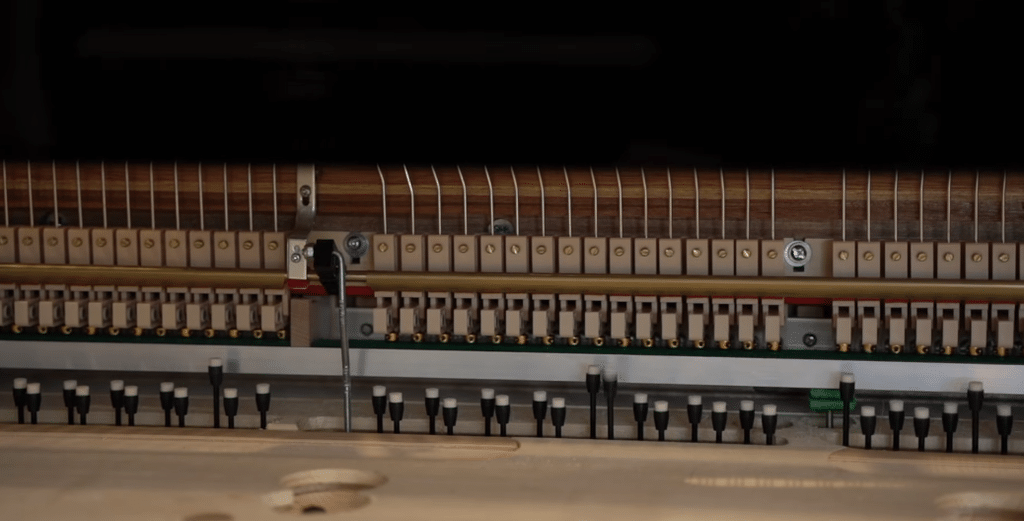
The world of pneumatic pianos has completely disappeared with the advent of modern self-playing pianos. Precision electromagnetic solenoids, one under each key and capable of more than 1,800 force gradations, are installed in instruments by companies such as Edelweiss, which manufactures acoustic grands by hand in Britain. The system reproduces not only the notes but also the precise weight and timing of each key depression by reading MIDI recordings taken from live concert performances.
Felt hammers on copper strings that reverberate through wood produce an acoustic sound every time. There is no speaker. Not a simulation. This piece was once performed by a pianist. Every time, the piano performs it flawlessly. It’s difficult not to feel a little uneasy when you walk into that room unprepared because it sounds so real.
There is an uncomfortable rhyme between the legal past and the present. In “White-Smith Music Publishing Co. v. Apollo Co”. (1908), the U.S. Supreme Court decided that piano rolls were “parts of a machine” rather than copyrighted copies. The following year, Congress swiftly passed legislation mandating royalties for both rolls and recordings.
AI music companies are currently negotiating remarkably similar challenges. While claiming that the practice is protected as fair use, Suno has admitted to using tens of millions of recordings to train its system. In November of last year, Warner Music Group settled with the business. Sony and Universal are still at odds with it. As technology advances, the law follows the creative sector adapts in ways that no one could have predicted.
While AI threatens some recording niches, Christopher White, a music theorist at the University of Massachusetts Amherst, believes it may actually make live performances more appealing. He states, “I think that most of those jobs are probably going to go away” in reference to commercial music jobs such as podcast themes and advertising jingles. It’s still unclear if the emergence of new musical genres would make up for that loss.
The player piano gave rise to a distinct class of workers, including composers who wrote music especially for the format, operators who maintained the machines, and technicians who recorded performances onto rolls. As young musicians, Fats Waller and Duke Ellington are said to have used piano rolls for practice. This history serves as a reminder that automation in music has rarely transpired as smoothly as either its proponents or detractors had anticipated.
There’s a feeling that the resurgence of the player piano, a real acoustic instrument that is now controlled by an iPad and draws from thousands of professionally recorded performances, is coming at the perfect cultural moment. The sound of strings vibrating inside a wooden cabinet feels meaningful once more when everything sounds digital.
The keys shift, the space shifts. The music is clearly audible even though no one is there. As AI-generated music becomes more difficult to tell apart from human-made music, it’s possible that listeners will want more of it rather than less. It’s possible that the old machine is hinting at something that the new ones still don’t fully understand.
FAQs
1. When did the player piano originate?
It was invented in the 1880s and peaked as a household item by the early 1900s.
2. How do modern self-playing pianos produce sound?
Electromagnetic solenoids trigger felt hammers on real strings — no speakers involved.
3. How does AI music compare legally to early player pianos?
Courts once called piano rolls “parts of a machine,” not copyrighted works.
4. What music jobs are most at risk from AI?
Commercial niches like podcast themes and advertising jingles face near-certain displacement.
5. Why are acoustic player pianos culturally relevant again?
Real vibrating strings feel meaningful precisely because so much music has gone fully digital.