
You’ll notice something odd if you’re close enough to a fairground organ. No musician is present. Not a conductor. All the work is done by folded cardboard moving through a frame inside a mechanical cabinet that sounds, improbably, like a full brass ensemble. For those who are interested in how sound has been preserved and reproduced over the past 200 years, that cardboard is known as “book music”. It is a subtly amazing invention.
Book music, which comes from the French “livre de musique”, is a way to store musical information on thick cardboard sheets that are punched through with holes and folded in a zigzag pattern. Every hole represents a note. Every location along the sheet’s width represents a distinct pitch. Melody and rhythm timing are determined by the order of holes as the book passes through the organ’s mechanism. Long before anyone thought to refer to it as such, it was essentially binary logic encoded in physical material.
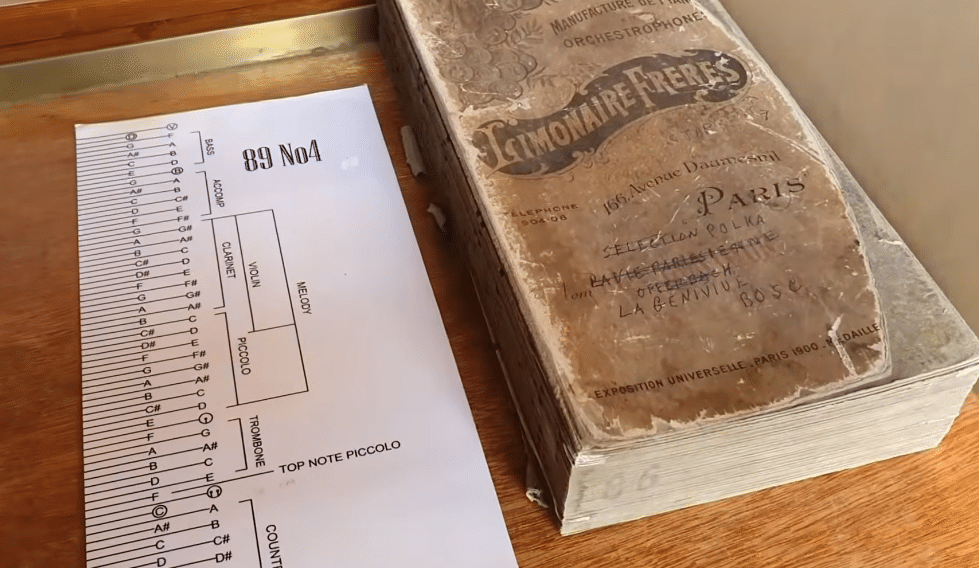
Practically speaking, Anselmo Gavioli, an organ manufacturer who patented the “book organ” in 1892, is the owner of the invention. Before his invention, fairground organs relied on heavy barrels with metal pins inside cylindrical drums that rotated to produce notes.
When you consider it, the issue became clear: a barrel could only accommodate a small number of songs; those songs had to fit within the drum’s fixed circumference. Everything was altered by Gavioli’s folded cardboard. All of a sudden, the size of the instrument no longer determined how long a piece of music would be. Up until his passing in 1910, Gavioli was Europe’s most renowned and successful manufacturer of fair organs. It’s easy to see why.
The mechanism that read book music was one of the practical details that made it truly clever. In the early iterations, the organ’s valves were mechanically triggered by keys, which were tiny levers that rocked upward when a hole passed beneath them. Builders eventually shifted to keyless frames, where the perforations allowed air pressure to perform the same function.
Pneumatically operated book music became particularly associated with German manufacturers, such as Gebr. Bruder and Ruth. In addition to being technically neat, switching from keys to air pressure significantly decreased wear on the books themselves, which had been a serious issue.
In Europe, book music was more popular than paper rolls, which were also widely used, due to a few unglamorous but significant advantages. Cardboard is not pliable. A piece of music may sound slightly different on a damp afternoon than on a dry morning because paper rolls expand and contract in response to changes in humidity.
Simply put, book music doesn’t have that issue. Additionally, there is no rewinding. While books fold back on themselves and are nearly instantly ready again, paper rolls require the instrument to pause in between songs while it winds the roll back. That is more significant than it may seem for a fairground organ that runs nonstop through a summer evening.
In the larger context of information storage, it’s worth taking a step back and considering what book music truly was. Long before digital computing came along to give that logic a name, the holes punched in that cardboard were encoding data: the presence or absence of a hole representing two states, a one or a zero.
The same reasoning underpinned Herman Hollerith’s census tabulation machines in 1890, Jacquard’s automated loom in 1805, and the punch cards that powered early computers until the middle of the 20th century. Because book music belongs to that lineage, it feels less like an eccentric mechanical curiosity and more like an early manifestation of a concept that proved to be fundamental.
The fact that book music persisted in Europe well into the modern era is noteworthy. While European fairground culture continued to favor cardboard books, American mechanical music culture moved primarily toward paper rolls and then swiftly toward the phonograph.
They are still frequently used today by the larger outdoor organs intended for public gatherings. This could be due to tradition, practical stubbornness, or simply the fact that cardboard with holes punched in it functions dependably in situations where electronics don’t always.
What book music actually symbolizes is the transition from stored music as a fixed object to a machine-readable, flexible language. When you consider how it was actually done, it is still somewhat amazing that a traveling fairground could arrive in a village with a repertoire of dozens of songs, packed in folded stacks of cardboard, filling the evening air with something akin to an orchestra. Holes in the cardboard. In a way, that’s what it boiled down to: the majority of recorded data still boils down to much smaller holes on much smaller surfaces.
FAQs
What is book music?
Thick punched cardboard folded in zigzag patterns that encodes musical notes mechanically.
Who invented the book organ?
Anselmo Gavioli patented it in 1892, replacing the older barrel-and-pin system.
Why was cardboard preferred over paper rolls?
Cardboard resists humidity and needs no rewinding, making it far more reliable.
How does the organ read the holes in the cardboard?
Early models used lever keys; later pneumatic systems let air pressure trigger the valves.
What does book music have in common with early computing?
Both encode data as binary states — hole or no hole, one or zero.