
A machine that plays music that no one asked it to play has a subtly unsettling quality. No oboist moistening a reed, no violinist shifting weight on a creaking stage chair, no conductor raising a baton. Just a cabinet, sometimes the size of a wall, sometimes the size of a wardrobe, humming, thumping, exhaling melody as if it had a place. That was the orchestrion, which was regarded as one of the most amazing possessions a wealthy person could have for a peculiar and fascinating period in history.
Fundamentally, the orchestrion was an automated musical instrument designed to mimic the sound of an entire orchestra. The tonal voices, which were voiced very differently from a typical church organ, were handled by pipes. The rhythmic framework was added by tambourines, cymbals, triangles, and percussion drums of various sizes.
A piano, with its recognizable keyboard serving as an anchor for everything else radiating outward, was a common feature of many models. A pinned rotating cylinder or, later, an unspooling paper roll was used to encode the music, with each hole or pin producing a distinct sound at a given time. In a way, it was programming in wood and brass instead of ones and zeros.
Johann Nepomuk Mälzel created the first known version in 1805 when he constructed what he called the panharmonicon. The panharmonicon was Mälzel’s most ambitious attempt to fit an orchestra inside a box. He was the kind of restless inventor who never seemed content with what already existed. Apparently enthralled with the concept, Beethoven wrote his “Wellington’s Victory” especially for it in 1813. This is a noteworthy footnote in and of itself: a major composer writing a piece not for human hands but for a machine.
Eventually, in 1811, one of Mälzel’s machines traveled across the Atlantic to Boston, where it was shown to interested audiences before moving on to New York and other cities. Until he died in 1838, Mälzel himself traveled the United States with it. For many Americans at the time, this might have been the closest they had ever heard orchestral music.
Michael Welte & Sons of Freiburg is the family that may have perfected the orchestrion. Welte Orchestrions became the instrument of choice for European royalty and the extremely wealthy as a result of their meticulous attention to craft, which began in 1832. One of their instruments, the Style 3, contained 180 metal and wooden pipes, drums of various sizes, triangles, and other percussion devices, all of which were folded into an oak cabinet with architectural details.
It was more than just music to own one. It was a declaration of your identity. There is a certain irony in that: among those who could most easily afford live performances, a machine built to replace musicians has become the ultimate status symbol.
The oldest son, Emil Welte, immigrated to the US in 1865 and patented the paper roll technique that would eventually lead to the creation of the modern piano roll in 1883. It’s one of those minor technological shifts that subtly transforms a whole sector. Longer, more intricate compositions could be encoded thanks to the switch from cylinder to roll, which also made the mechanism more repeatable and, despite its smaller size, more portable.
Playing with emotion was something that the orchestrion found difficult, at least initially. According to those who used them later, the early pneumatic systems driven by mechanical blowers or hand-pumped bellows were rhythmically imprecise. According to jazz guitarist Pat Metheny, Flabby once talked about his grandfather’s antique player piano.
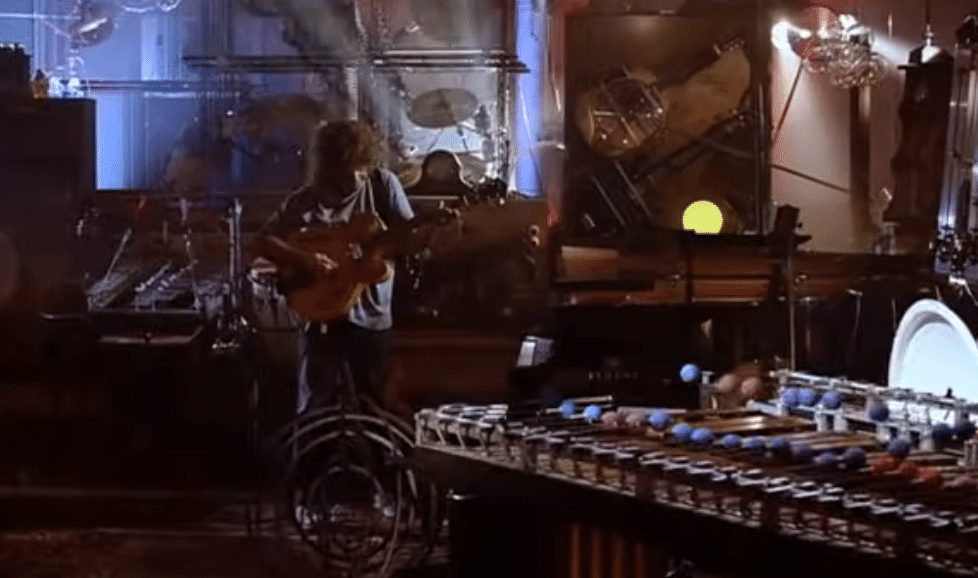
For a 2010 album, Metheny reimagined the orchestrion concept by putting together an automated robot orchestra using MIDI and solenoid instruments that were specially made by engineers in Brooklyn. His main grievance with the historical originals was straightforward: why was the music always required to be so boring? It’s a legitimate query. It was an amazing mechanism. Seldom did the repertoire match it.
It wasn’t superior engineering by a rival that killed the orchestrion in the end. The phonograph was the culprit. When cylinders were able to record and replay an imperfect, human, unrepeatable performance, the argument for a machine that could replicate that performance gradually waned.
Strangely enough, the orchestrion was the first recording device that allowed a composer to perform their work precisely as intended without physically being in the room. The same promise was made and improved upon by sound recording.
That trajectory contains something worthwhile. A machine designed to mimic the sounds of numerous people was eventually replaced by a machine that recorded the sounds of real people. Eventually, algorithms performing the same function at a scale those Victorian engineers could not have predicted took its place.
In that chain, the orchestrion occupies a peculiar, neglected position that is unmistakably both art and technology. Some of them are still performing today in museums and private homes, drums tapping and pipes breathing in spaces that have a subtle scent of wood polish and another century. If you have the opportunity, it’s worth listening to one.
FAQs
What is an orchestrion?
An automated instrument that mimicked a full orchestra using pipes, percussion, and encoded music.
Who built the first orchestrion?
Johann Nepomuk Mälzel constructed the panharmonicon in 1805.
Why did Beethoven compose “Wellington’s Victory” for a machine?
He wrote it specifically for Mälzel’s panharmonicon rather than live performers.
What company became the most celebrated orchestrion maker?
Michael Welte & Sons of Freiburg, whose instruments were prized by European royalty.
What killed the orchestrion’s popularity?
The phonograph replaced it by capturing real, imperfect human performances instead.