
Act I of “The Pirates of Penzance” appears to have caused audiences in 1879 to burst into knowing laughter when the curtain rises, and a haughty, mustachioed officer walks onstage to brag about his extraordinary credentials in mathematics, ancient history, and fine art while cheerfully admitting he knows almost nothing about actual soldiering. They believed they knew who the man was.
Most people thought it was Sir Garnet Wolseley, the most renowned general in Britain at the time, whose name had come to be associated with military prowess to the point where “All Sir Garnet” had become a common expression that meant everything was in order. It’s a fair assumption. According to reports, George Grossmith, who portrayed Major-General Stanley in the original London production, purposefully imitated Wolseley’s posture and his noticeably large mustache. The audience understood it right away.
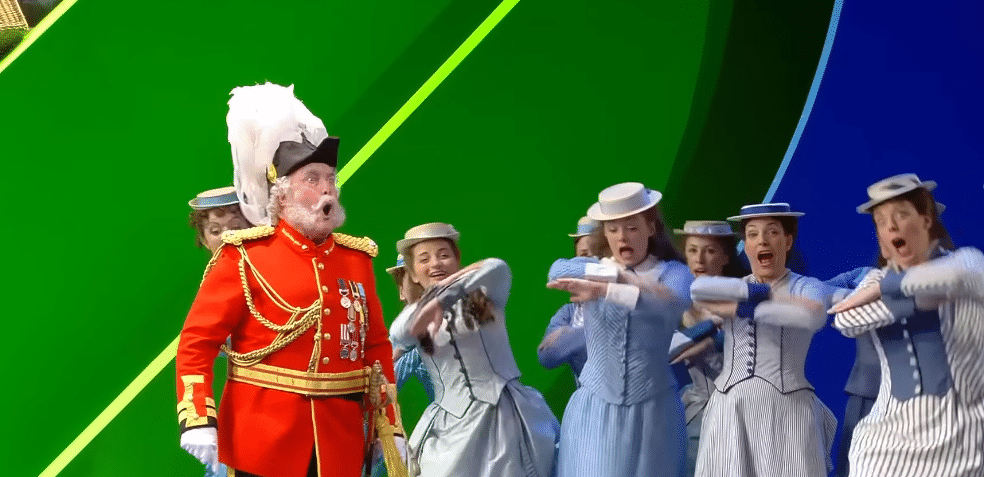
The fact that W.S. Gilbert might not have been considering Wolseley at all is peculiar and possibly a little depressing. Gilbert’s biographer, Michael Ainger, persuasively argues that the real inspiration was a much less glamorous figure: General Henry Turner, Gilbert’s wife’s uncle, whom Gilbert seemed to find intolerable and enjoyed subtly mocking. That possibility has a profoundly human and petty quality. A satirist dressing up as a personal annoyance in public would not be unprecedented.
Even without its theatrical setting, the song “I Am the Very Model of a Modern Major-General” is truly remarkable as a work of literature. Because it’s a patter song, the lyrical density is nearly ridiculous; the song’s success depends on how quickly it is delivered. The Major-General asserts that the croaking chorus from Aristophanes “The Frogs”, fluency in binomial theorems, and Babylonian cuneiform are the distinguishing features of authentic Raphael paintings.
He is aware of the legendary past of King Arthur. He has the ability to hum a fugue. He freely admits, with a sort of joyful bluster, that he is unable to distinguish a Mauser rifle from a javelin or comprehend what “commissariat” really means. He acknowledges that his military expertise dates only to the turn of the century. That’s a pretty big gap because the opera takes place in 1879.
The satire targets a specific aspect of Victorian Britain: the educated gentleman officer, a byproduct of classical education and the public school system, who gained authority through social standing rather than tactical aptitude.
The type wasn’t created by Gilbert. He was naming it with a song that he performed eight times a week in the most publicly humiliating manner possible. Whether Wolseley or Turner was the target, the criticism fell on a whole class of men, which is likely why it persisted long after most people had moved on from either inspiration.
It turns out that Wolseley himself seemed content with everything. According to his biographer, he would occasionally sing the song for family and friends and took no offense at the public identification. It’s difficult to interpret that. Wolseley either genuinely didn’t realize the joke was on him, or he had an exceptionally strong ego. Maybe both. Wolseley might have been the kind of powerful man who is treated with mockery as a kind of tribute.
Since then, the song has developed a life of its own. It is now a sort of cultural shorthand for the humor of exaggerated credentials because it has been parodied and pastiche-written so frequently. It was incorporated into “Hamilton” by Lin-Manuel Miranda. Over 19 million people have watched the Minions’ rendition of it in “Despicable Me 3” on YouTube.
“Scrubs” featured Dr. Cox raging to its beat. In “Mass Effect 2”, Dr. Mordin Solus proclaimed himself the epitome of a scientist salarian. Every adaptation is a tiny argument that the original recognized something enduring about a particular type of human pretense that the intricate resume put together to hide a basic shortcoming.
It’s hard not to think that Gilbert stumbled upon something greater than either Wolseley or Turner when you watch all of this build up over almost 150 years. The Major-General functions as a character because he is produced by practically every institution in practically every era, rather than because he represents a particular individual.
He appears at conferences, dinner parties, boardrooms, and committees, projecting impressive knowledge while secretly hoping that no one asks about anything truly pertinent. The type is still present, which makes the song humorous. Probably the most awkward aspect of the entire joke is that.
FAQs
Q1: Who inspired the character of Major-General Stanley?
Likely Gilbert’s wife’s uncle, General Henry Turner, whom Gilbert found intolerable.
Q2: What is the central joke of “I Am the Very Model of a Modern Major-General”?
The Major-General boasts vast academic knowledge while admitting total ignorance of actual soldiering.
Q3: How did actor George Grossmith shape audience perception of the character?
He mimicked General Wolseley’s posture and distinctive mustache, making audiences assume him the target.
Q4: What class of person does the satire actually criticize?
Victorian gentleman officers who earned authority through social rank, not military competence.
Q5: How has the song remained culturally relevant since 1879?
It’s been parodied in Hamilton, Despicable Me 3, Scrubs, and Mass Effect 2.