
The sound of a carousel spinning at full speed across an open fairground on a summer evening is one type of music that is more likely to stick in your memory than in your ears. The majority of people never consider asking where it originates.
Few people are aware that the solution can be traced back to a single Italian-French family that operated out of Paris in the nineteenth century and created machines that were capable of doing something that no musician could: play continuously, without pausing, without getting tired, without requesting payment.
Giacomo Gavioli established his organ-building business in Cavezzo, a small town in northern Italy, in 1806. This is where the Gavioli story starts, not in Paris. The creation of automatic musical instruments, such as bird organs, flute clocks, and other devices that produced sound without the use of human hands, was his hobby, and it’s important to note that it was initially just a hobby.
Perhaps Giacomo had no idea what that early obsession would turn into. But it was obvious that his son Lodovico had higher goals. For the Duke of Modena, Lodovico constructed the Panharmonico, a complete orchestrion organ, but he refused to buy it. Instead of folding the instrument, Lodovico packed it and transported it to Paris and London. One of two things usually happens with that kind of unyielding confidence. Everything went perfectly for the Gaviolis.
By 1845, Lodovico had permanently moved the family business to Paris, which at the time was the unchallenged hub of the European organ trade. Lodovico’s three sons, Anselme, Henry Claude, grew up in a world where the company started manufacturing instruments with real scale and ambition from the Rue d’Aligre.
Anselme was the one who would make a lasting impression. He created what he called the “frein” in 1878, a tiny piece of metal that could bend a pipe’s sound to resemble the warmth of a violin or cello. Only someone who had spent years listening intently to mechanical music would even consider attempting such a precise, almost fussy innovation.
What followed was much more significant. Anselme patented a system known as “book music” in 1892. It involved feeding zigzag-folded sheets of perforated cardboard through the organ so that mechanical arms could “read” the holes and activate the valves. Prior to this, fairground organs were powered by big wooden cylinders that operated on the same fundamental principle as a music box.
These cylinders had a set, limited capacity for both the number of songs that could be stored and the duration of a piece of music. That restriction was essentially eliminated by book music. Now that folded cardboard books were inexpensive to make and simple to exchange, music could run virtually endlessly. It’s difficult to ignore how similar the reasoning is to what transpired with digital formats a century later: everything changed the instant the container stopped restricting the content.
By the end of the nineteenth century, fairground culture was already changing. The old cylinder organs were unable to accommodate the growing number of rides and louder crowds. The instruments of Gavioli could. They were designed to be audible over the cacophony of hundreds of people and machinery.
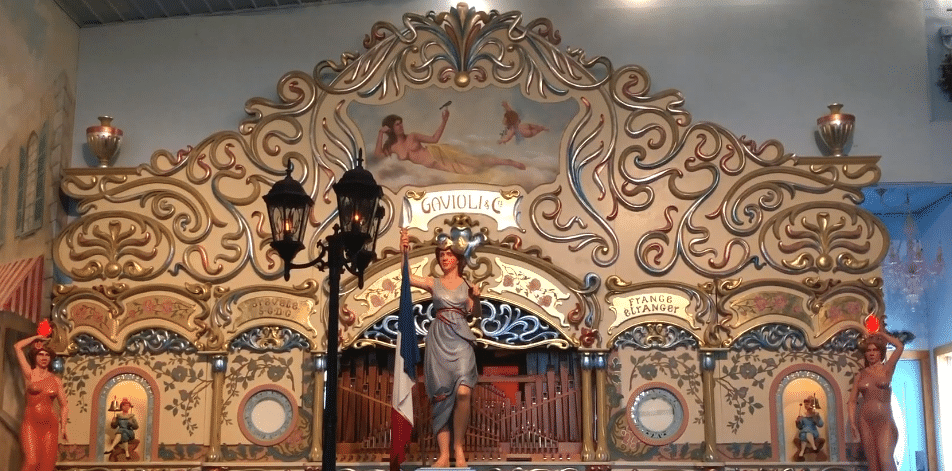
They were large, imposing, and as elaborate in appearance as they were in sound, with carved facades, moving automaton figures, and conductors whose arms beat time in the open. In hindsight, it is clear that the showmanship was integrated into the product itself. The music at a fairground had to fill the air and draw attention at the same time.
Ludovico II, Anselme’s son, inherited the company after he died in 1902. The business did not fare well in the following ten years. By 1912, Gavioli had completely stopped producing organs. The remaining patents and assets were transferred to Limonaire Frères of Paris, a name that would later become so synonymous with fairground organs in France that “limonaire” became the general French term for the device. It’s a bittersweet kind of legacy. The invention endures, but the name fades.
Nowadays, surviving Gavioli organs can be found all over the world, including in the US, Japan, and the UK. The Steam Carousel at the Dutch theme park Efteling is home to one of the most well-known. The organ from Cleveland, Ohio’s Euclid Beach Park is still undergoing restoration, which seems appropriate given that it was designed to never stop playing and is being persuaded to return to sound.
It’s still unclear if they will bring it back to life completely. It appears that Anselme Gavioli’s folded cardboard books encoded something that proved to be surprisingly durable, as evidenced by the fact that people are still trying more than a century after the family that built it broke up.
FAQs
Q: Who founded the Gavioli organ-building business?
Giacomo Gavioli founded it in Cavezzo, northern Italy, in 1806.
Q: What was “book music” and who invented it?
Anselme Gavioli patented it in 1892 — perforated cardboard sheets that organs could “read” mechanically.
Q: Why did book music revolutionize fairground organs?
It removed the song-length limits of wooden cylinders, allowing music to run almost endlessly.
Q: When did Gavioli stop making organs?
The company ceased production entirely by 1912.
Q: Where can surviving Gavioli organs be found today?
Examples exist in the US, UK, Japan, and the Dutch theme park Efteling.