
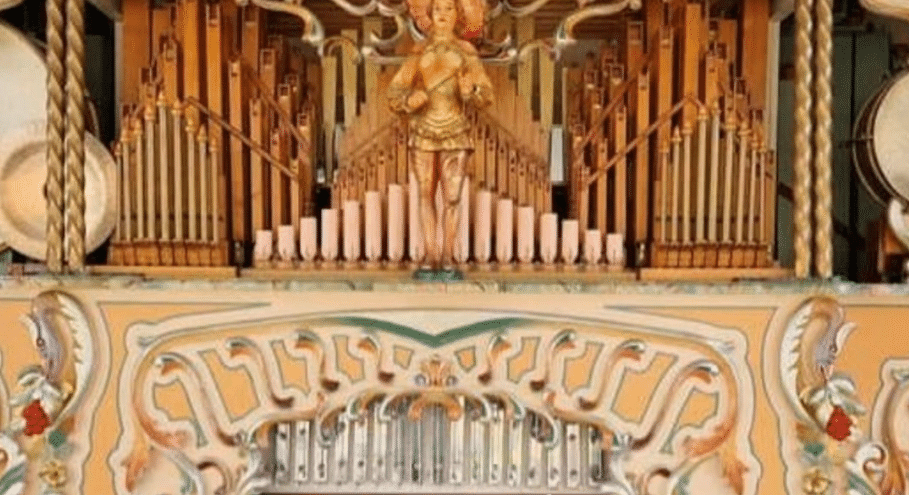
If you’ve ever been close enough to a functioning fairground organ, there’s a moment when you forget where you are. A conductor figure swings its golden arm in time to a march from a different century; the pipes speak, the drums strike on their own. Clearly, it’s mechanical. That’s not how it feels. Something seems to be alive within the cabinet.
For more than a century, craftsmen throughout Europe were motivated to create these instruments by this feeling, which was a mixture of wonder and mild unease. Fairground organs were essentially portable orchestras that were invented in Paris at the beginning of the nineteenth century.
Their purpose was to project music loud enough to drown out the sounds of spinning rides and yelling crowds. For decades, the trade was strong enough to support rival workshops in France, Belgium, Germany, and eventually Britain. The Limonaire Frères company, which opened on Avenue Daumesnil in 1839, helped define what these machines could do.
Now, that world has mostly vanished. The organ’s commercial dominance at fairgrounds was quietly ended by the introduction of electrical amplification in the mid-1920s; the manufacturers who had supplied showmen for generations gradually wound down or vanished completely. It may come as a surprise that some British artisans never really stopped. They continued to create new organs from scratch for collectors and enthusiasts who still desired the original, sell parts, cut new music books restore vintage instruments.
One such builder was Peter Trueman of Derby. His instruments circulated among collectors for years because they were small, useful, and engineered with the kind of precision that comes from truly understanding how pneumatic action works. Trueman is credited with creating a 49-keyless organ with 150 pipes, a glockenspiel, a traditional bellows, and a bandmaster figure on the façade. It’s the kind of organ that implies its creator was equally interested in theater and engineering.
Working in the early 1990s, David Leach created hand-turned street organs with decorative veneering and inlaid banding on the case. These instruments were later modified to read MIDI files from an SD card, a hybrid approach that seems to be typical of how the trade has survived by grafting new technology onto old forms rather than giving up either.
Businesses like A C Pilmer have been in this market for decades, trading in reconditioned instruments, composing original music, and handling the kind of specialized knowledge that isn’t found in manuals. Their catalogs read like little archeological surveys: a 46-key Gavioli organ that was found in the United States and is thought to have lived its whole life there before being brought back to Britain and overhauled.
A fully restored Wilhelm Bruder Starkton model with 600 meters of freshly cut music composed by Gustav Bruder; a Limonaire organ that traveled through Rotterdam, several Dutch towns, a fairground ride, and finally a specially constructed close-coupled trailer before arriving in the English market. Every instrument has a complex history; those who work with them typically have a thorough understanding of it.
The number of active builders who will begin with raw materials and create a functional fairground organ on commission is more difficult to determine. It appears that the parts are still present. There is a continuous trade in cases, pipe ranks, keyframes, bellows, and other components.
One advertisement that is making the rounds among enthusiasts offers the shell of a large, unfinished instrument that is veneered both inside and out and is described as the possible foundation for a new concert organ or large fairground organ. It’s another matter entirely whether the personnel capable of finishing such a project are as readily available as the components.
Whether this craft has enough apprentices to continue for another generation is still up for debate. The knowledge needed to control a pneumatic keyframe or voice a rank of saxobass pipes primarily resides in the minds of those who learned by observing others. The collectors are getting older; the fairs that formerly required these machines have long since moved on.
Speaking with professionals in the field gives one the impression that the art form is both more resilient and more vulnerable than it appears. Resilient because, with proper maintenance, the instruments themselves last for well over a century. Precarious because the knowledge needed to keep them up to date doesn’t happen on its own.
For the time being, Britain still has music cutters, restorers, and organ builders. The machines continue to operate. Every summer at steam fairs, you can hear them doing exactly what they were designed to do: projecting sound across an open field, above the din of engines and people, totally unaffected by the century they live in.
FAQs
Q: Where did fairground organs originate?
They were invented in Paris at the start of the nineteenth century.
Q: What ended the fairground organ’s commercial dominance?
Electrical amplification, introduced in the mid-1920s, made them commercially obsolete.
Q: Are fairground organs still being built today?
A small number of British craftsmen still build them on commission.
Q: What is the biggest threat to this craft’s survival?
The specialized knowledge lives in aging practitioners with few apprentices replacing them.
Q: How long do well-maintained fairground organs last?
With proper care, the instruments remain functional for well over a century.