
The picture has an almost cinematic quality. In a ballroom on the Lancashire coast, a young organist from Sheffield, who is only twenty-five years old, sits down at a 2/10 Wurlitzer and is told quite bluntly that both he and the organ are out if he can’t get people to dance in a strict tempo. He gets them to dance. For forty years, he continues to make them dance.
In March 1930, Reginald Dixon, not a well-known figure, arrived at the Tower Ballroom Blackpool as a workable solution to an issue that two other organists had been unable to resolve. The Wurlitzer was amazing. The acoustics were superb. It took more than just musicianship to keep 7,000 dancers on time; Dixon needed a certain kind of instinct, a physical connection to rhythm that he had been cultivating since he was two years old.
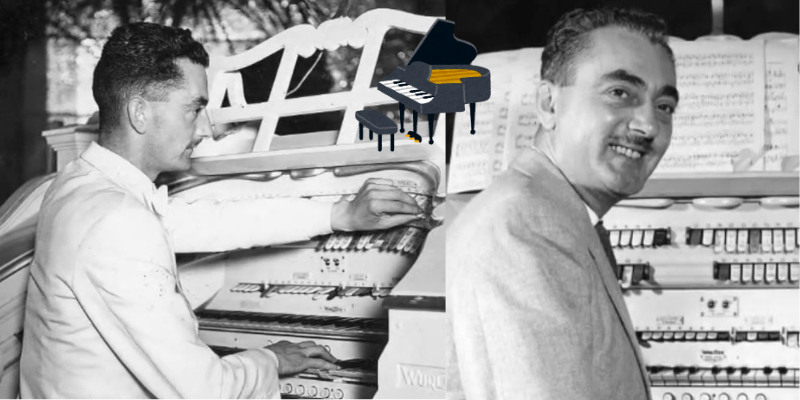
Dixon’s playing was instantly unique due to a biological accident. His predominant left-handedness influenced everything. His right hand was free to elaborate, fill in, and decorate, while his left hand managed the accompaniment rhythm. In that sense, it sounds straightforward. It was quite different to hear it or even to imagine the impact it had on a crowded ballroom in 1931.
Within weeks of his appointment, the BBC acknowledged it. Broadcasts from the Tower began almost immediately; by 1931, they were airing five times a week for thirty to forty-five minutes, reaching not only Britain but also Canada, India, Africa, and Australia. Before the majority of people in those nations had ever heard of Blackpool, Dixon was broadcasting live from the Golden Mile to the British Empire.
Now, it’s easy to underestimate how uncommon this was. Early in the 1930s, radio was still developing its vocabulary and figuring out what sounds would translate. Dixon somehow made the transition flawlessly while performing in a large ballroom with superb acoustics. He was named the nation’s most popular cinema organist by the “Daily Mail” in 1933.
With twice as many votes as the person who came in second, the “Daily Express” declared him to be Britain’s top organist by 1938 following a national reader poll. Victor Silvester and Bing Crosby were in the same commercial conversation as him. Sitting with that still seems amazing.
Winter was a different time of year. Dixon’s tour of concert halls and movie theaters throughout the United Kingdom was packed, much like the Tower Ballroom was in the summer. Blackpool was completely sold out. Dixon seems to have never really gone through a slow phase.
Even after making over a thousand broadcasts and pushing himself to the point of true exhaustion, he became gravely ill in 1952, but his recovery was short-lived; the pace quickly returned. Queen Elizabeth II’s statement that she frequently listened to him on the radio during the 1955 Royal Variety Performance is preserved in the record as a sort of formal affirmation of what the public had known for twenty years.
The organ itself expanded alongside him. He had completely outgrown the original 2/10 Wurlitzer by 1935, at which point the Tower Company replaced it with a 3/13 instrument with thirteen ranks, a console capable of orchestral complexity. The phone lines were reportedly inundated with praise when that initial broadcast was made.
Turning on Blackpool’s illuminations in 1956 seemed like the appropriate next honor, a ceremony televised across Europe, given to a man who had effectively become the town’s most famous resident. This kind of detail seems exaggerated until you consider that Dixon’s audience at this point was measured in millions per broadcast.
The BBC recorded and aired his farewell performance on Easter Sunday in 1970, the year he retired from the Tower. Actually, it wasn’t retirement. He continued to tour organ societies in the Netherlands, and they kept contacting him because they wanted him on television and radio.
In May 1985, Dixon passed away in Blackpool. Since 1930, he had been there. The sound he created left hand steady, right hand free, bass deep, dependable still defines what people mean when they talk about the Tower Ballroom. He recorded more than any organist before or since.
After taking over in 1977 and earning his own MBE in 2010, Phil Kelsall claims that he first became infatuated with Wurlitzer while watching Dixon perform as a young boy. It’s difficult to ignore the fact that Dixon established a tradition that was robust enough to generate its own successor without seeming to cause any problems.
Every day the ballroom is open, the organ rises from underneath the stage on a hydraulic platform. Compressed air, a thousand pipes, those renowned acoustics. You can hear it and instantly know where you are, according to Kelsall. That certainty was created by Dixon.