
The Rudolph Wurlitzer Company was finishing and shipping one theater organ every day in 1926, at the height of the silent film era. It’s difficult to visualize that figure. Each instrument had hundreds of pipes ranging in length from pencil-thin to thirty feet or more, weighed several tons, and needed its own special chambers built into the structure. The console, which was the organist’s curved, horseshoe-shaped desk surrounded by colored stop-tabs, was merely the portion of the apparatus that was visible. The actual equipment was located inside the walls, beneath the stage, backstage.
Nevertheless, the majority of those instruments had become silent by the middle of the 1930s. Within a few years, synchronized sound in movies changed everything. Theater owners acted swiftly when Al Jolson’s voice emerged from the speakers at the close of the 1920s.
The economics were straightforward: compared to a live organist, recorded sound was more reliable and less expensive. By the early 1930s, the majority of American cinema equipment had been turned off, taken out, or left to sit in vacant rooms that were no longer in use. Only a few hundred of the more than 5,000 instruments produced by various manufacturers during the silent era are still in use today.
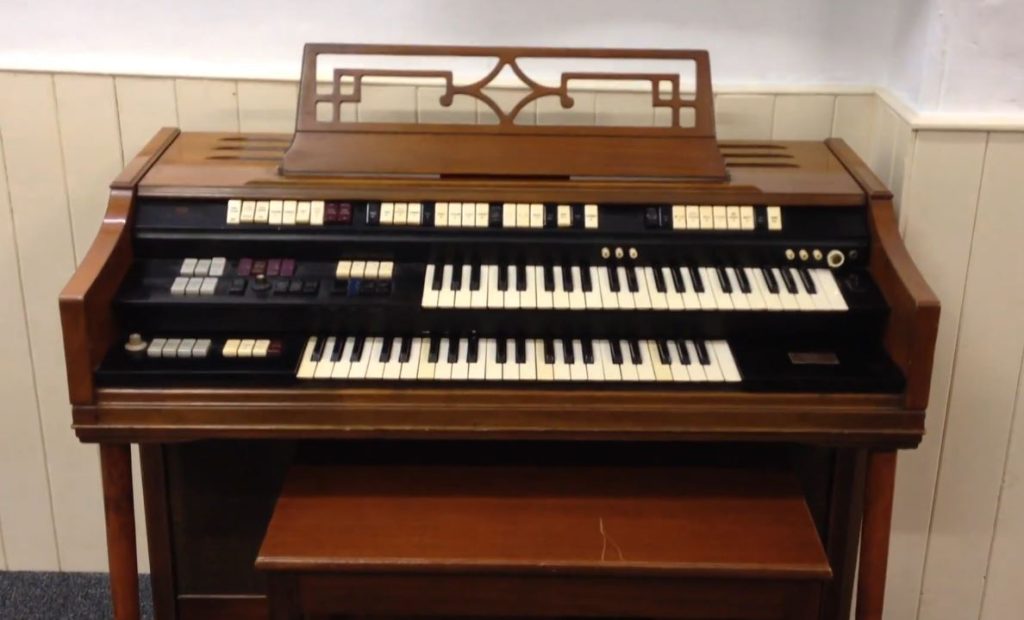
One of the most peculiar tales in musical history is what transpired next. Private collectors purchased a large number of organs. Some were installed in homes, which required constructing special pipe chambers in a person’s living room. This dedication reveals something about the depth of emotion these instruments evoked. Some made their way into dining establishments.
In the 1960s, pizzerias in California began purchasing them after one proprietor found that a Wurlitzer drew patrons and kept them at their tables longer. To everyone’s surprise, pipe organs from the silent era began to emerge from under the floors of Italian restaurants as the phenomenon spread throughout the state and eventually the entire nation.
The trip took a slightly different route in Britain. Wurlitzers had been imported into the UK since the late 1920s, and before World War II, about 200 were sold in British theaters. Through the 1930s and into the postwar years, British audiences continued to enjoy the cinema organ as entertainment in and of itself, in contrast to America, where the instruments became silent almost immediately after the talkies arrived. Organists rose to minor celebrity status.
Regular Wurlitzer performances were televised by the BBC, and the instruments at places like Blackpool’s Tower Ballroom drew devoted audiences. In a way that proved more enduring than in the nation that produced the instruments, the image of a formally attired organist rising through the floor on a hydraulic lift had become ingrained in the national consciousness.
Nevertheless, the inevitable thinning out took place. Their organs needed a place to go as British theaters closed during the 1960s and 1970s, turned into bingo halls, or were completely demolished. Town halls, concert halls, heritage museums, and, in some cases, rather unexpected parts of the country were among the places that preservationists, organ societies, and individual enthusiasts sought to find for them.
One such location was the Magnificent Music Machines collection in St Keyne, Cornwall, which included a vintage Wurlitzer and other mechanical musical instruments in an environment that was hardly more dissimilar from the urban picture palaces for which these instruments were designed. Actually, there’s a subtle rightness to that. A theater organ fits the pattern better than it might appear because Cornwall’s old mills and converted spaces have always drawn items that needed to be preserved.
Every time one of these relocations occurred, it’s important to know exactly what needed to be moved. The console, which was portable and about the size of a small car, was the simple part. The pipes were a different story. Several hundred pipes arranged into six to twenty-two ranks may be found in a typical Wurlitzer of the type found in a medium-sized British theater. Every rank required a separate chamber, wind supply, and blower system connection.
In order to reinstall an instrument, a room had to be built specifically for that purpose. Before being transported to Britain in 1934, the 1927 Wurlitzer at the Windermere cinema in Cumbria played in a Cleveland, Ohio, theater. It required years of fundraising and restoration work before it could be heard once more. Saving these instruments will require a significant commitment.
Watching this history gives me the impression that the Wurlitzer organ has a peculiar place in popular culture. It is familiar enough that Monty Python could make fun of the rising console and expect the audience to understand it, but it is not well-known enough that the majority of people have ever sat in a room and listened to one. The organs that endure in Brentford, Devon, Worthing, and Cornwall are sustaining something truly unique. It’s not nostalgia per se, but rather the sound of what moviegoers heard before movies started talking.