
There is an instant difference between sitting at a church organ and a theater organ. Although the keys, pedals, and stops on the console may appear somewhat familiar, the reasoning behind everything changes. One instrument was designed with reverence in mind. The other was constructed for display. Knowing that difference reveals something genuinely fascinating about the past of entertainment and music.
Since the Middle Ages, the church organ has existed in a variety of forms. It gradually changed over centuries to accommodate liturgical music, such as Bach, congregational hymns, and the kind of sound that reverberates throughout a stone cathedral. Typically, church organs designate a keyboard for each rank of pipes.
The clarinet rank is assigned to a single manual and remains there. Precision is rewarded by the instrument. For years, musicians practice reading three staves at once: treble for the right hand, bass for the left, and a third for the feet on the pedals. They then play exactly what is written on the page. It has an almost architectural sense of discipline.
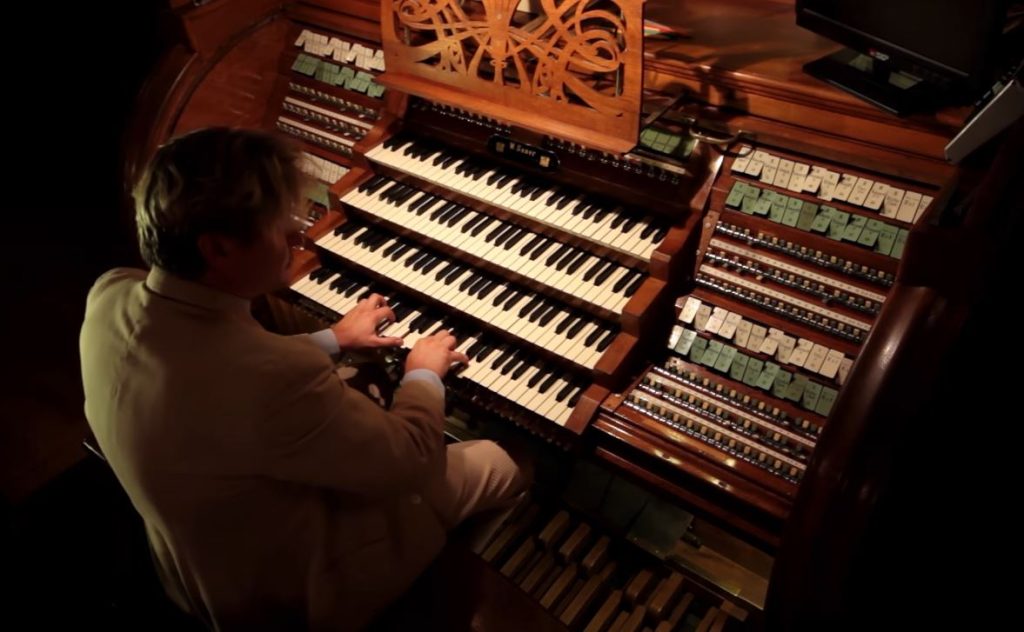
Credit: Xaver Varnus
The pressures that led to the development of the theater organ were entirely different. Silent films in the early twentieth century required sound. Live orchestras were costly, logistically challenging, and difficult to accommodate in smaller spaces. English engineer Robert Hope-Jones, who was fascinated by organ mechanics, saw a chance. He completely rethought the classical organ, viewing it not as a liturgical instrument but rather as a “Unit Orchestra.” The concept was that one musician, seated at a sophisticated console, could create the sound of a full band in an entire theater.
Hope-Jones had to violate a number of regulations to make that work. Theater organs employ unification, which allows a single rank of pipes to be played simultaneously at various pitch levels on all of the keyboards. On a theater organ, the same clarinet pipes that are locked to a single manual are available everywhere.
Theater pipes have a louder, more powerful voice from a physically smaller package because the instruments operate on much higher wind pressure, sometimes five to ten times greater than that of a church organ. With a foot pedal, the organist can adjust the volume of swell shades, which are basically enormous mechanical shutters, from a near-whisper to something that can fill an auditorium with a thousand seats. Theater organs got their distinctive warm, vibrato-rich sound by refining and applying much more force to the tremulant, a device that produces a slight wavering in the pipe tone.
Then there were the extras. A real xylophone, chimes, a snare drum, cymbals, and sound effects, such as boat whistles, automobile horns, bird calls, and even a surf simulation, could all be found in a fully functional theater organ. They weren’t exactly gimmicks. The audience felt the train whistle when a locomotive appeared on screen, and the organist played it. Strangely enough, the theater organ was the first attempt at what sound designers in movies now spend millions of dollars on.
It takes truly different skills to play the two instruments. A church organist with classical training reads music in the same way that a conductor reads a score: every gesture is intentional, and every note is prescribed. In the past, a theater organist would improvise. Formal arrangements hardly existed in the 1920s. Filmmakers gave artists “cue sheets,” which were rough suggestions about what kind of music would be appropriate for a particular scene, such as a chase, a love story, or a riot. The artists then mostly created the rest in real time.
Like a jazz bassist, the pedals turned into a bass line. Chords on the lower manual were composed by the left hand. The melody was carried up top by the right hand. The renowned organist at Radio City Music Hall, Dick Liebert, is said to have never performed a song the same way twice. Classical organ training is practically the opposite of that kind of fluid, impromptu musicianship.
As a result, even for skilled organists, switching between the two instruments is still surprisingly challenging. With its intricate relay system, percussion effects, and horseshoe-shaped arrangement of colored stop tongues, a theater organ console can truly bewilder a church musician. A different but no less perplexing task confronts a theater organist seated at a conventional draw-knob church console who must sight-read three staves without improvising a single measure. Simply put, the skills don’t transfer well.
It’s important to note that these instruments are currently part of an odd cultural moment. Only about forty of the thousands of theater organs that were installed in American theaters between 1915 and 1933 are still in good condition. Some have found themselves in churches, which is a peculiar irony in and of itself. Meanwhile, churches are discreetly debating whether to replace their outdated pipe organs with digital ones or to keep them at all. Although Allen, Hauptwerk, and other digital systems can replicate both instruments with surprising fidelity, the technology has advanced to the point where enthusiasts on both sides often feel that something is lost in translation.
When you watch a talented theater organist perform, you get the impression that you’re witnessing something that doesn’t quite fit into any contemporary category. The music is not classical. It’s not jazz. It’s unique and has its roots in a particular era when movies were still in their infancy, and a single person with a sophisticated keyboard had to capture everyone’s attention.
With centuries of tradition ingrained in each pipe voicing and meticulously notated score, the church organ also bears a certain amount of weight. These two instruments have a familial resemblance, but their souls are distinct. Once you hear that difference, it is difficult to ignore it.