
Of all places, Florence was where it all began. For his Medici patron, a craftsman by the name of Bartolomeo Cristofori created something unique around 1700: a keyboard instrument that could be played loudly and softly. This is exactly what its original Italian name, “gravicembalo col piano e forte”, meant. It remained a curiosity for decades because it was too costly and difficult for the average person to care about. Everything changed when it landed in Britain after crossing the Channel.
There is something strangely specific about the moment that actually started things. A German immigrant named Johannes Zumpe had been discreetly refining Cristofori’s invention in London in 1768, but he needed a famous person to validate it.
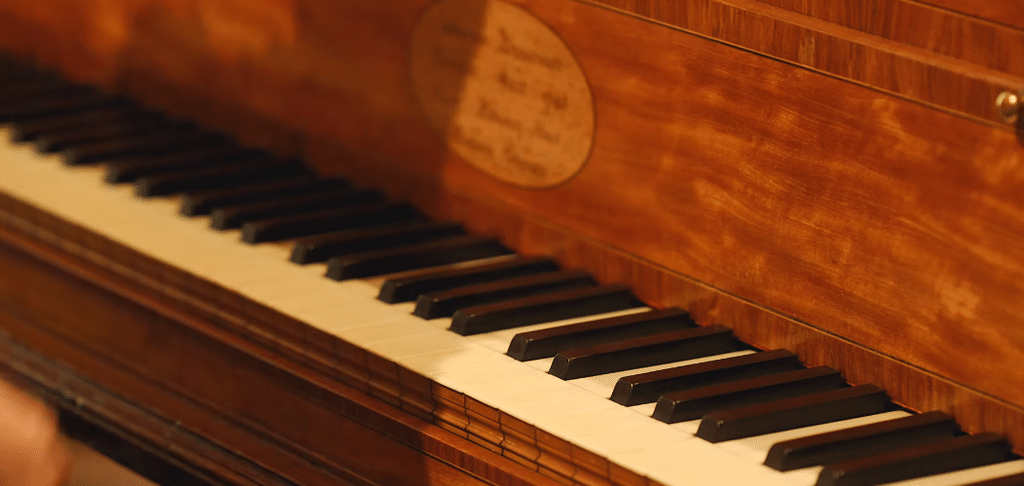
He located renowned musician Johann Christian Bach, Queen Charlotte’s personal music instructor, who consented to give a public performance on a Zumpe piano. It’s difficult to ignore how much of history depends on events like this: when a single influential person shows up and plays a few notes, an entire instrument suddenly becomes popular.
Bach’s support was crucial, but Queen Charlotte’s close involvement was just as important. In Britain, where the middle class was just starting to establish itself, aspirational items had a way of spreading quickly the piano became, almost overnight, a symbol of social aspiration. By the early 1800s, a piano in the living room was more about your family’s status than it was about music.
Fathers purchased them because a daughter who played was seen as more marriageable, not because their daughters had a gift for melody. Women were encouraged to play privately and attractively rather than professionally and publicly due to the blunt reasoning and unfair expectations.
The gendered nature of the entire story has a subtle peculiarity. In general, young men did not take lessons, but young women did. Most of the time, women who demonstrated true talent, the kind worthy of a concert stage, were excluded from it.
The notable exception was Clara Schumann, who established a career in spite of the widespread belief that virtuosity was a male accomplishment. In the meantime, composers like Haydn, Mozart, and Beethoven were creating extremely difficult works that were partially influenced by the talent of female pianists they personally knew. The music continued. The social norms didn’t, at least not right away.
Something more democratic was also taking place outside the gentry’s drawing rooms. As British prosperity spread throughout the 19th century, more families, not just the aristocracy, were able to purchase a piano.
This was significant because, prior to the invention of recordings, music had to be created by those who wanted to hear it. Together, the Haydn family sang. Songs were passed down orally by working people. Instead of displacing that tradition, the piano complemented it; it provided a new, more sophisticated instrument for domestic music-making and a reason to congregate around the parlor rather than the hearth.
It should be noted that playing the four-hand piano with two people sitting next to each other at a single keyboard became a popular pastime. It was also one of the few acceptable ways for a young man and woman to sit close to each other. In Victorian Britain, courtship and music were never truly distinct. People seemed to understand this completely and just decided not to express it aloud.
With the introduction of the player piano, phonograph, and radio in the early 20th century, the whole system began to fall apart. You could just listen instead of practicing. During the 1930s Great Depression, piano sales fell precipitously; some manufacturers never recovered.
The piano didn’t vanish, so it’s still unclear if what came next was a true decline or just a narrowing. It focused. Today’s instruments are typically more expensive and of higher quality than they were fifty years ago, indicating that playing has once again become more closely linked to wealth and education.
In a sense, the social history of the British piano tells the tale of who is allowed to engage in culture and under what conditions. It started in Florence’s palaces, evolved into a middle-class status symbol in Victorian Britain, influenced how women were viewed eventually made its way into bars and classrooms. It was never merely a tool. It was a disagreement about your identity.
FAQs
1. Who invented the piano?
Bartolomeo Cristofori built it in Florence for his Medici patron around 1700.
2. How did the piano catch on in Britain?
Johann Christian Bach’s 1768 public London performance turned it into an overnight sensation.
3. Why did Victorian families rush to buy pianos?
A piano in the parlor signaled social status, not musical passion.
4. Why were women expected to play more than men?
Playing was a feminine social accomplishment, not a route to professional performance.
5. What ended the piano’s mass popularity in the 20th century?
The phonograph and radio meant people could listen instead of learning to play.