
A pipe organ has a subtle stubbornness to it. It’s not streaming. It is not very good at compressing. The BBC Theater Organ was the beating heart of British radio for more than 50 years, surviving bomb damage and changing tastes during at least one wartime evacuation before its last notes echoed out of a Manchester playhouse in 1990. It takes up enormous physical space, requires skilled hands to play sounds nothing like the pop music that eventually crowded it off the airwaves.
Like many BBC stories, this one begins with a real-world issue. Early organ broadcasts in Britain in the 1920s relied on borrowed spaces such as the New Gallery Kinema on Regent Street, Shepherd’s Bush Pavilion, and London’s Steinway Hall. These agreements were successful until they weren’t. Renting space on someone else’s property had clear limitations because late-hour live broadcasts required dependable, easily accessible equipment.
With 2,826 pipes spread over 35 ranks, the BBC’s first in-house Compton organ was installed at Broadcasting House in 1933. On June 16, 1933, it was unveiled with a concert that included George Thalben-Ball and some of the best organists of the time. The only issue was that Broadcasting House was never quiet because the organ’s sound leaked into nearby studios. The instrument was hardly ever used.
Three years later, the real BBC Theater Organ the one that people truly refer to when they use the phrase was created. The story starts to come to life in 1936 when a four-manual Compton Melotone was installed at St. George’s Hall in Langham Place, right across from Broadcasting House. In just two years after being named resident organist, Reginald Foort introduced 72 guest organists to the microphone and performed over 400 solo broadcasts.
The volume of that output, its sheer frequency, and the impression that the organ was hardly ever silent are difficult to ignore. His successor, Sandy MacPherson, was reportedly playing up to twelve hours a day when war broke out in September 1939, and the BBC quickly switched to light music programming. Twelve hours. As the outside world grew uncertain and dark, the organ served as a sort of national comfort blanket, keeping the radio warm.
Then came the bombs. September 1940, May 1941, and March 1943 all saw attacks on St. George’s Hall. The original Compton was demolished. What came next was an oddly humane solution: Foort lent the BBC his own “Travelling Möller”, a massive touring organ made to his specifications by Danish-American craftsman M. P. Möller that was intended to be transported between locations.
The broadcasts continued after it was first established in Bangor, Wales, near MacPherson’s residence in Llandudno. The Möller was eventually purchased outright by the BBC in 1946 and placed in an abandoned chapel in Hoxton, where it stayed for eighteen years before being sold to Netherlands Radio VARA. There was an afterlife for even the improvised solution.
Blackpool, of all places, was the birthplace of the third and last official BBC Theater Organ. Since April 1935, a Wurlitzer, originally the organ in the Tower Ballroom, has been housed in the Empress Ballroom at the Winter Gardens. It was moved and enlarged from 10 to 13 ranks with a brand-new three-manual console.
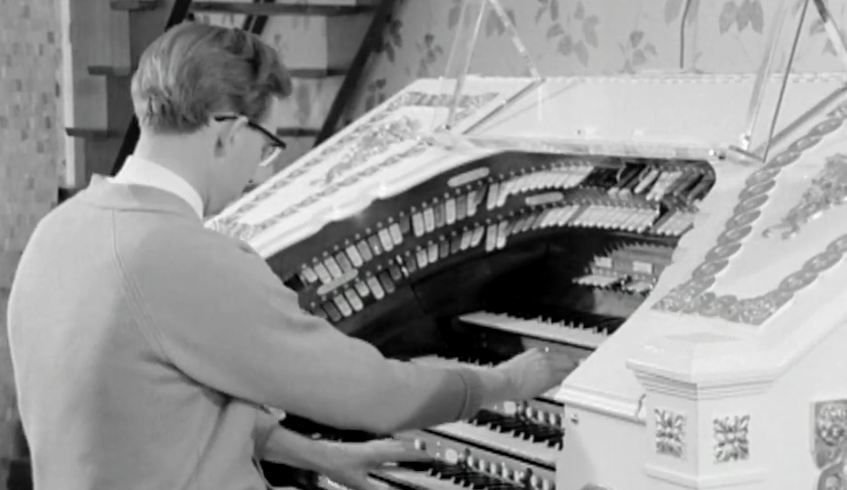
Organists like Horace Finch, Watson Holmes, and Ernest Broadbent performed it for dancers and guests for more than thirty years. The Wurlitzer had no place in the ballroom when it was transformed into a nightclub in the late 1960s. The BBC recognized a chance. The organ was taken out of Blackpool in late 1969 and reinstalled as BBC Theater Organ No. 3 at the BBC Playhouse Theater in Manchester.
On November 12, 1970, Reginald Dixon, Ernest Broadbent, and Reginald Porter Brown performed at the gala edition of “The Organist Entertains” in Manchester, which was hosted by Robin Richmond. Before retiring in 1969, Dixon worked for decades at Blackpool’s Tower Ballroom. In a way, he was moving north with his instrument.
Nigel Ogden, Dudley Savage, and Robin Richmond all performed from Manchester during the BBC Playhouse era, which continued into the 1970s and 1980s until a change in BBC policy put an end to the broadcasts. The organ was eventually sold and partially disassembled in 1985, with its pipes and chambers dispersed to augment instruments elsewhere.
On July 14, 1990, the last broadcast featuring anyone billed as performing “at the console of the BBC Theater Organ” was released. Harold Robinson Cleaver, the organist, was playing from a recording that was made three years prior to his passing.
The last performance was already a ghost of itself; the instrument was long gone, but the music managed to make it onto the air in a way that was almost poetic. In reality, the BBC Theater Organ was more than just an organ. For a long time, Britain appeared to need this specific method of filling the void.
FAQs
1. What was the BBC Theater Organ?
A series of organs that provided live music for British radio broadcasts from the 1920s onward.
2. Why did the BBC install its own organ instead of renting venues?
Renting external spaces made late-night live broadcasts unreliable and logistically difficult.
3. How did the BBC continue organ broadcasts during World War II?
Organist Reginald Foort lent the BBC his personal touring Möller organ.
4. Where did the final BBC Theater Organ come from?
A Wurlitzer originally housed in Blackpool’s Winter Gardens Empress Ballroom.
5. When did BBC Theater Organ broadcasts end?
The last broadcast aired July 14, 1990, using a recording made three years earlier.