
There’s something quietly disorienting about watching a piano play itself. The keys dip and rise without a single finger touching them, the tempo holds, the melody unfolds, and somewhere in the middle of it, you start to wonder who, exactly, is in the room with you.
That feeling came back sharply after reading about a visit to an old manor house on a lake, where a host dug through dusty boxes and pulled out a roll of George Gershwin playing his “Rhapsody in Blue”. The mechanism was loaded, the tempo set within seconds, and the room was transformed. One person sat at the keyboard, mesmerized. It’s hard not to understand why.
The object doing all of this the thing that made Gershwin appear, in some sense, in a house decades after his death is a piano roll, and it’s less complicated than you’d expect, more remarkable than it has any right to be.
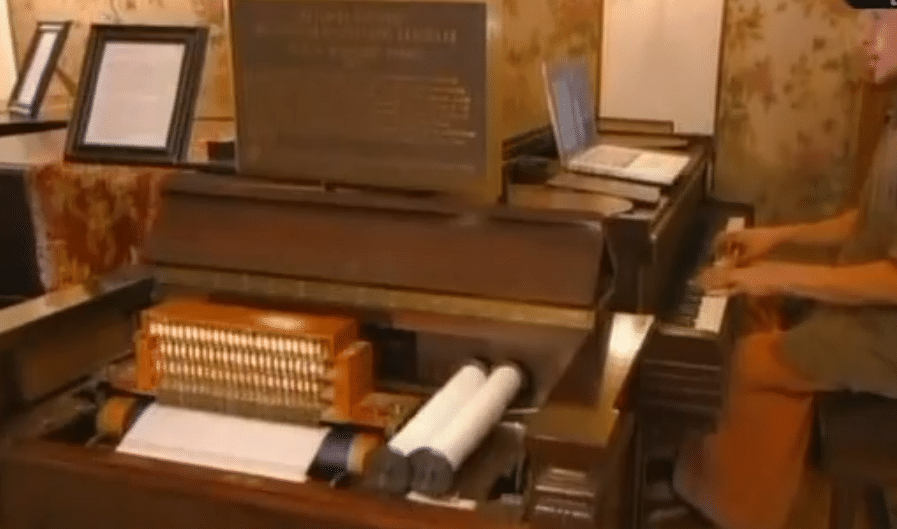
At its core, a piano roll is a continuous length of paper with holes punched through it. That’s it. Those perforations represent musical notes: their pitch, their duration, their sequence. As the paper travels across a reading mechanism called a tracker bar, each hole triggers a note. Pneumatic pressure does the mechanical work. The paper does the memory work. Together, they produce music.
The first commercial use dates to 1883, when the German firm Welte & Sons used paper rolls in their orchestrions. By 1896, the format had reached the United States in a workable form; the standardization arguments began almost immediately, with different scales, different widths, and different hole densities for different pianos.
A 1908 gathering in Buffalo, New York, attempted to settle things, landing on an 11¼-inch width and a perforation standard that became a loose global norm. It’s the kind of unglamorous industry meeting that nobody remembers, but everybody benefited from.
Not all piano rolls are created equal; that distinction matters more than it sounds. Metronomic rolls were arranged by hand, precisely positioned, and played back with mechanical regularity, useful tools for pianists who wanted to add their own dynamics via the controls. Hand-played rolls captured a live performance in real time, a pianist sitting at a specially wired recording piano while the notes were marked onto a blank roll, and then there were the reproducing rolls, the serious ones, the ones with ambitions beyond mere transcription.
Reproducing rolls didn’t just record the notes. They encoded the dynamics, the pedaling, the subtle variations in touch that make one pianist sound nothing like another. Brands like Duo-Art and Ampico Welte-Mignon each developed their own systems of control perforations extra markings toward the edges of the roll that told the playback piano.
How hard to strike each note, when to lift the soft pedal, when to let a chord ring. Some of these encoding methods were technically sophisticated. Some were proprietary secrets. Some apparently relied heavily on a producer’s handwritten notes and a fair amount of intuition.
The results were striking enough that a music critic at London’s Aeolian Hall reportedly couldn’t tell, with his eyes closed, whether he was hearing a live pianist or a Duo-Art roll. That detail is either wonderful or slightly unsettling, depending on your mood.
Among the pianists who made reproducing rolls: Rachmaninoff, Debussy, Scriabin, Saint-Saëns at eighty years old, Scott Joplin, George Gershwin. Mahler. Stravinsky didn’t just record his existing works; he rewrote them for the player piano specifically, then composed an original “Etude for Pianola” in 1917. Over a hundred composers wrote music conceived entirely for a mechanical instrument, music that no human hands could play even if they tried.
The format peaked between roughly 1900 and 1927, then collapsed as radio and recording technology improved. But it didn’t vanish entirely. Rolls are still being produced today; QRS Music reportedly maintains a catalog of 45,000 titles, and the concept survived in a different form.
Every digital audio workstation in use today features something called a piano roll editor: a grid-based interface where musical notes appear as horizontal bars, pitch on one axis, time on the other. The name isn’t coincidental.
What those long sheets of paper with their frayed edges and carefully punched holes actually preserved is something harder to name than data. They captured the moment before recordings felt natural, when the only way to freeze a performance was to translate it imperfectly.
Into a set of mechanical instructions and trust that something of the original would survive the translation. Mostly, it did. Sometimes, listening to a reproducing piano play back a roll from 1919, it seems to have survived completely.
FAQs
1. What is a piano roll?
A continuous paper strip with punched holes that trigger notes via pneumatic pressure.
2. When were piano rolls most popular?
They peaked between roughly 1900 and 1927, before radio eclipsed them.
3. What made reproducing rolls different from standard ones?
They encoded dynamics, pedaling, and touch — not just the notes themselves.
4. Which famous composers recorded on piano rolls?
Rachmaninoff, Debussy, Gershwin, Scriabin, Stravinsky, and even Saint-Saëns at eighty.
5. How do piano rolls connect to modern music software?
Today’s DAW “piano roll editor” takes its name directly from them.